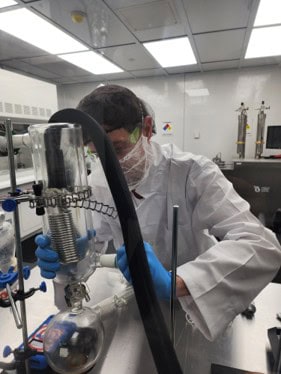
Technician in Seven-10’s GMP-certified manufacturing facility — Montego Bay, Jamaica
Building a pharmaceutical manufacturing platform is not a straightforward undertaking anywhere. Building one from the ground up in a Caribbean Special Economic Zone, navigating multiple sovereign regulatory frameworks simultaneously, during the global COVID pandemic, is a different order of difficulty entirely. And Cathcart did it.
Seven-10 Pharmaceuticals is a GMP-certified, licensed pharmaceutical manufacturing and export platform purpose-built for the production and cross-border commercialization of regulated pharmaceutical products. The facility operates within its own dedicated Special Economic Zone — a designation Cathcart successfully petitioned the Government of Jamaica to create specifically for this platform. The platform was designed from the outset for multi-jurisdictional compliance, with export pathways into the United States, Brazil, and the Caribbean, built to operate at the intersection of manufacturing, regulation, and international trade.
The Seven-10 platform required navigating 14 government agencies spread among 7 different government ministries to secure 4 licenses, GMP certification, free trade zone status, and a 50% corporate income tax abatement. Each of those approvals involved at least one distinct regulatory body, and oftentimes multiple regulatory bodies needed to be coordinated at once. Each license and certification had its own distinct process, and a distinct set of institutional counterparties — in a jurisdiction where the regulatory architecture for pharmaceutical manufacturing was itself still maturing.
Building the Platform
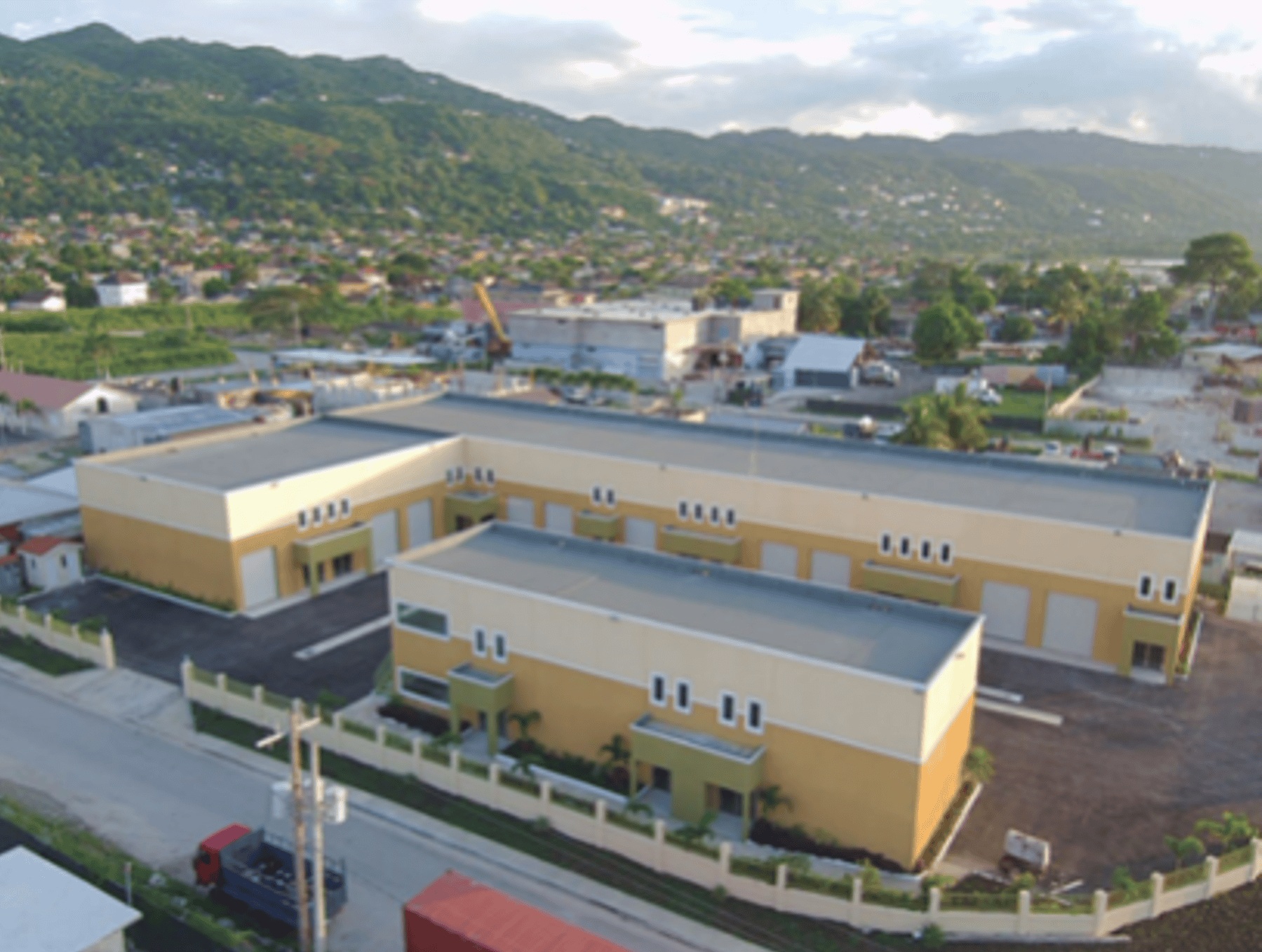
Seven-10 Pharmaceuticals facility — Montego Bay, Jamaica
Cathcart led the full operating architecture build across multiple jurisdictions simultaneously: licensing, GMP compliance, manufacturing capability, export infrastructure, regulatory positioning, product development, distribution, and partner strategy. This was not a sequential build — each workstream had to advance in parallel because progress in one jurisdiction was often contingent on demonstrating progress in another. A manufacturing license required proof of a compliant facility. A compliant facility required GMP certification. GMP certification required an inspection-ready operation. Getting all of those conditions to converge, in a Caribbean jurisdiction during COVID, with international travel restricted and government offices operating at reduced capacity, required sustained operational discipline over several years.
The U.S. pathway required DEA import approvals for Schedule 1 controlled substances — among the most tightly regulated import categories in the United States federal system. Obtaining those approvals required demonstrating that the facility, its security protocols, its chain-of-custody documentation, and its personnel met the DEA’s exacting standards for handling controlled substances at the international level. The Brazil pathway required ANVISA approvals, establishing the compliance architecture for market entry into one of the world’s largest pharmaceutical markets — a country with its own distinct regulatory framework, language, and institutional requirements that had to be navigated independently of the U.S. pathway.
The manufacturing facility itself was built to EU-GMP compliant specifications — a higher standard than the minimum required for Jamaican licensing — using modular cleanroom technology manufactured by a leading U.S. cleanroom builder. That decision reflected a deliberate strategic choice: build to the most demanding standard available so the platform can access the most demanding markets, rather than build to local minimums and retrofit later.
Cross-Border Regulatory Architecture
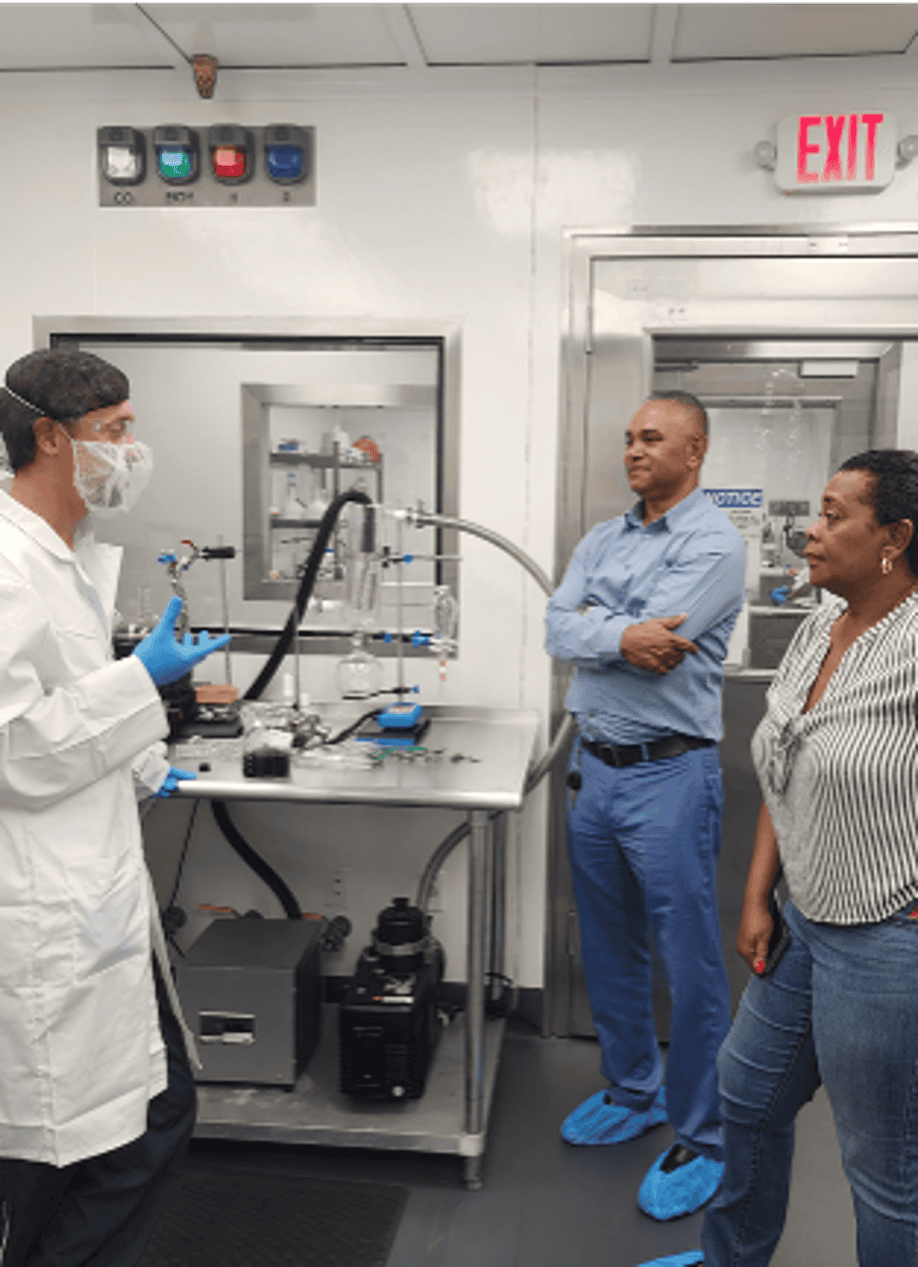
Seven-10 Pharmaceuticals facility — Montego Bay, Jamaica
On the commercial side, Cathcart negotiated a joint venture distribution agreement providing access to more than 13,000 pharmacies across Brazil — building the downstream channel in parallel with the upstream manufacturing and compliance infrastructure. That commercial foothold did not happen in isolation. It was the product of years of regulatory groundwork, relationship building, and demonstrated compliance credibility with Brazilian counterparties and institutions.
The regulatory dimension of this platform extends beyond the facility itself. In both Jamaica and Mexico, government bodies sought out Cathcart on a pro bono basis for his specific expertise in cross-border pharmaceutical governance and best practices for emerging regulated product categories — areas where those governments were building frameworks from scratch and where his cross-border operating experience filled a gap their own institutions did not yet have. He engaged with the Ministry of Justice of Jamaica and COFEPRIS, Mexico’s federal health regulator, advising on licensing frameworks, compliance standards, and the practical realities of operating across multiple international regulatory systems simultaneously. That kind of engagement — where a government invites a private operator in because he knows more about a specific frontier than they do — is not a standard credential. It reflects both the depth of the expertise and the trust those institutions placed in him.
The compliance architecture Cathcart built for Seven-10 spans four regulatory jurisdictions simultaneously — the United States, Brazil, Mexico and Jamaica — each with distinct licensing requirements, import and export protocols, and institutional counterparties. The U.S. framework is governed by the DEA and FDA. The Brazilian framework is governed by ANVISA, one of the most rigorous pharmaceutical regulators in the world. The Mexican framework is governed by COFEPRIS. The Jamaican framework required navigating a regulatory environment that was still being built in real time, with the Pharmacy Council of Jamaica (PCJ) , the Ministry of Health and Wellness (MOHW), and the Jamaica Special Economic Zone Authority (JSEZA) all playing distinct roles. Aligning those three frameworks into a single coherent operating platform — where product manufactured in Jamaica can move through compliant channels into both the U.S. and Latin Amderican markets — required the same skills that underpin every frontier venture Cathcart has built: translating institutional complexity into executable architecture.
Special Economic Zone
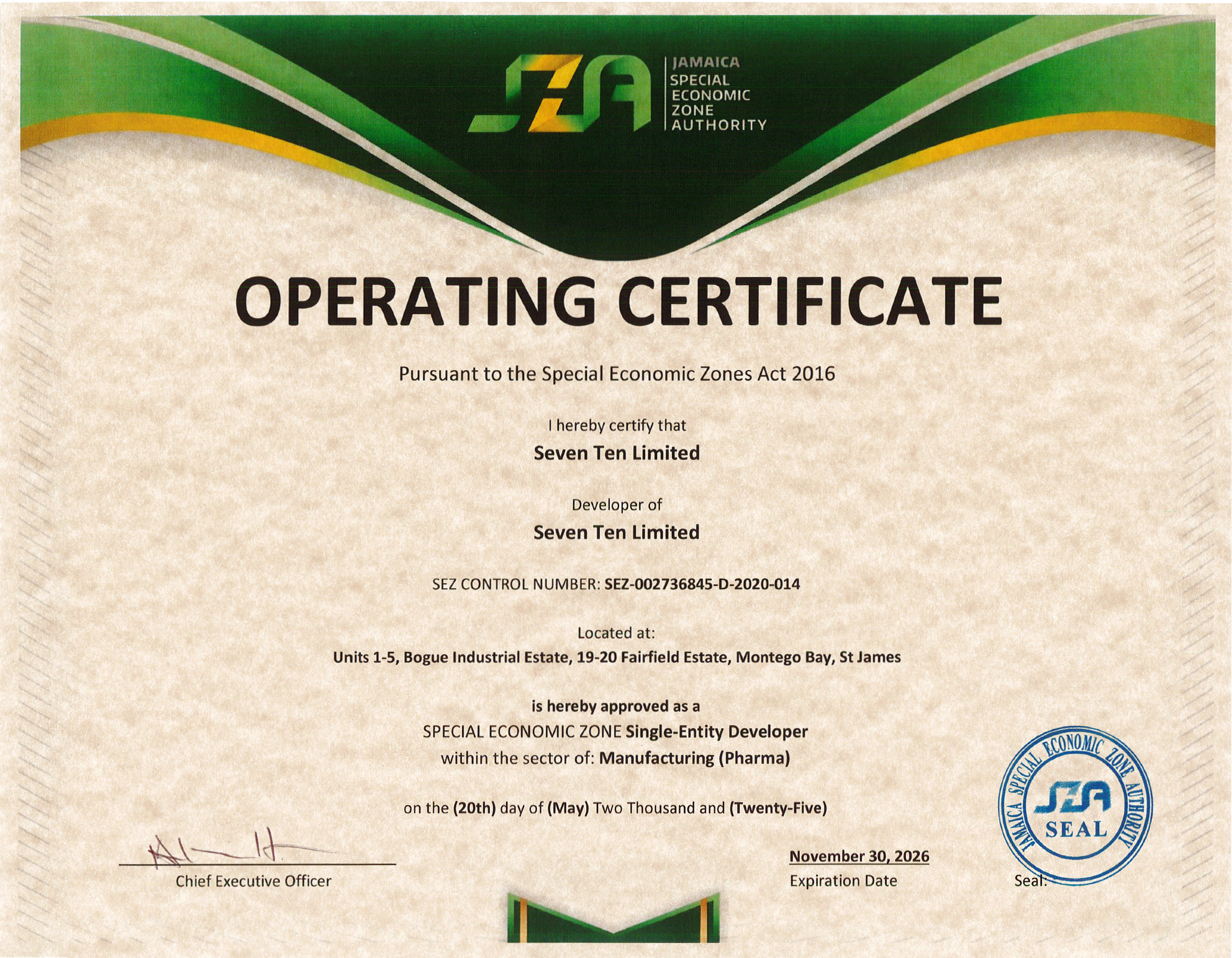
Jamaica Special Economic Zone Authority — Operating Certificate, Pharmaceutical Manufacturing
Most companies that operate in a free trade zone move into an established one. Cathcart took a different path. He successfully petitioned the Government of Jamaica to designate Seven-10’s own facility as a standalone Special Economic Zone — a Single-Entity Developer designation under the Jamaica Special Economic Zones Act 2016. That designation was granted by order of the Prime Minister and gazetted in the Jamaica Gazette. It is not a standard outcome. It required sustained engagement with multiple government ministries and regulators, a credible operating plan, and the institutional credibility to make the case from scratch.
The operational consequences of SEZ status are significant. The designation enables duty-free and tax-free imports, preferential re-export terms, and a regulatory environment specifically structured to support international trade at scale. For a pharmaceutical manufacturing and export platform targeting the U.S. and Brazil, it positions the facility as a compliant staging and distribution hub for regulated product moving across multiple international channels — not merely a domestic manufacturer with export aspirations.
The 50% corporate income tax abatement that accompanies SEZ status reduces the effective corporate income tax rate to 12.5% — a structural cost advantage that compounds at scale and forms part of the platform’s competitive position in cross-border pharmaceutical supply.
The Broader Pattern
Seven-10 Pharmaceuticals is not just a pharmaceutical story. It is a frontier platform-building story. The same operating logic under which Cathcart developed blast-resistant modular structures for the U.S. Air Force and a modular, scalable reconstruction framework for the Iraqi government produced a GMP-certified pharmaceutical manufacturing platform in a Caribbean free trade zone. Each of these ventures required building something complex that did not exist, in an extremely challenging environment that not only did not make it easy but the opposite, against a regulatory and institutional backdrop that most operators would have found prohibitive.
That is the consistent pattern with Cathcart. Complex environments, first-of-its-kind execution, multiple extreme — and extremely difficult — scenarios and deliverables aligned at once. Seven-10 is the most recent example of Cathcart bringing vision, strategy, order and execution in a challenging frontier environment.
For professional inquiries, contact Cathcart here.