Logistics is not a standalone capability. For Scott Cathcart, it has always been the operational layer that makes everything else possible — the mechanism by which an idea, a building system, or a reconstruction framework actually moves from concept to deployment.
The question he consistently asked was: if the solution exists, how does it get there at scale?
Commercial Infrastructure —
A Scale Partnership with Maersk
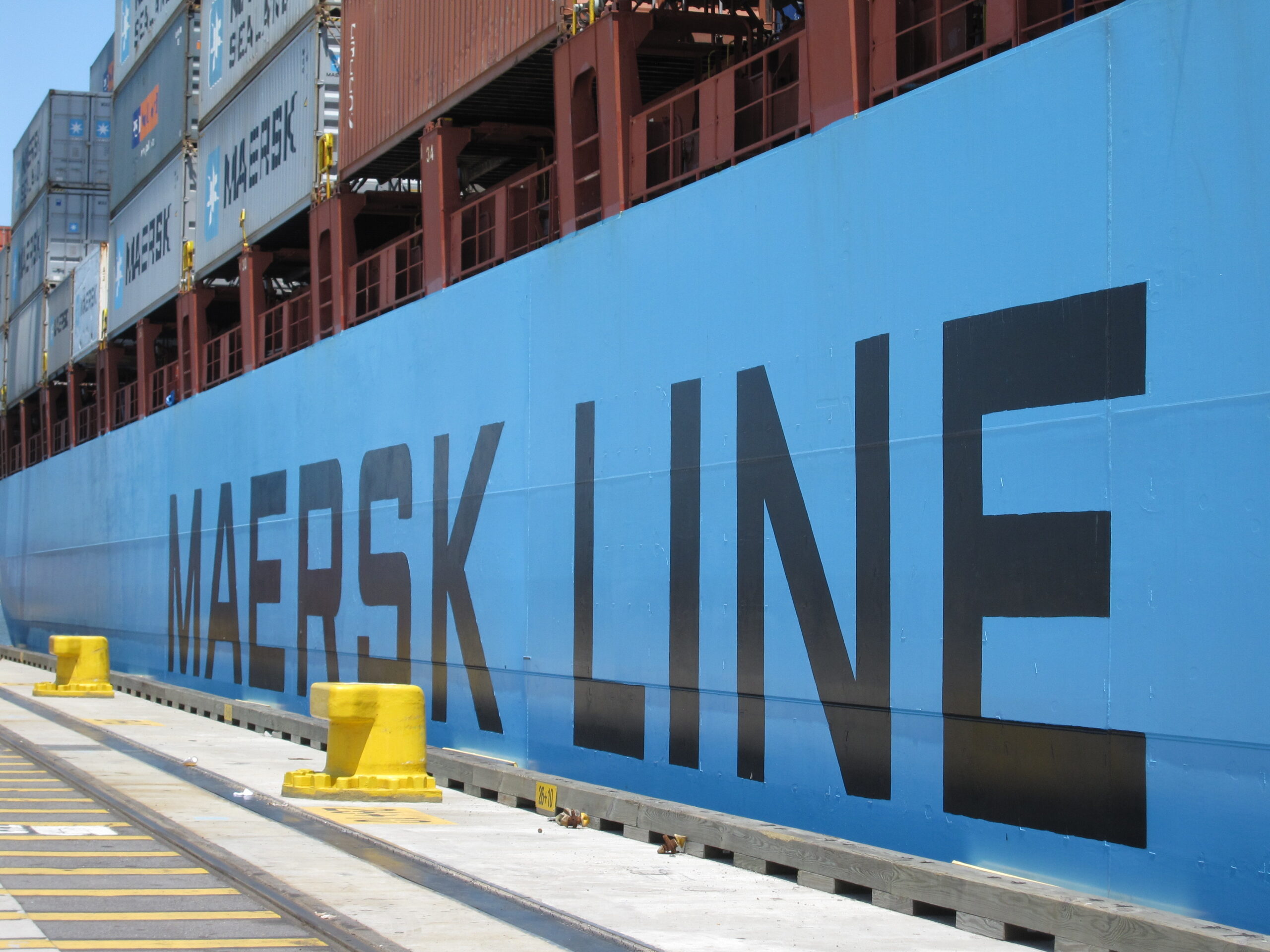
A Maersk Line container vessel dockside — Cathcart’s strategic partnership with Maersk gave the modular building system access to the world’s largest shipping network and manufacturing capacity.
In the midst of the global financial crisis of 2008, Cathcart recognized something others missed. The financial crisis had collapsed Maersk’s shipping volumes and left significant idle capacity across both Maersk Line’s container fleet and Maersk Container Industry’s manufacturing operations in Dongguan, China. At the same moment, the scale of demand in active conflict zones and disaster environments was enormous — and conventional construction and logistics frameworks were wholly inadequate to meet it.
Cathcart’s insight was to connect those two realities.
He approached Maersk with a proposal to integrate the modular building system of a construction technology company he founded — a unique structural system engineered to the dimensions of an ISO container for optimal logistics fluidity — into Maersk’s idle manufacturing capacity, and to deploy finished buildings and building modules at scale into war-zone and disaster relief environments, as well as large commercial deployments. The proposition was straightforward: fill idle container vessels with completed structures and knock-down (KD) units, all sized to ISO-certified container dimensions. Use MCI’s excess capacity in China for cost-effective production at scale for non-U.S. military markets. Use U.S.-based manufacturers for domestic military and government production. Then use Maersk’s global logistics expertise to synchronize it all — and deliver at a volume and speed that conventional construction could never match.
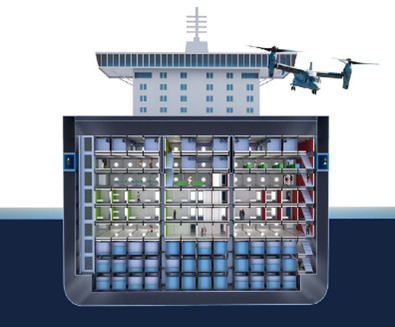
Afloat Forward Staging Base concept — a converted Maersk container vessel outfitted with multi-deck modular habitation, medical, command and control, and aviation support systems, jointly developed with Maersk for U.S. Navy and Marine Corps deployment.
Maersk agreed. What followed first was a significant joint development program. Together, Cathcart and Maersk designed and engineered a complete modular conversion solution for Maersk container vessels — transforming each commercial hull into an Afloat Forward Staging Base (AFSB) capable of housing and supporting hundreds of military personnel across multiple fully equipped decks: berthing, dining, medical facilities, armories, repair workshops, command and control, and aviation support. Each hold was designed as a self-contained, fully operational unit, scalable to mission requirements. The program addressed both Navy requirements and the Marine Corps’ planned relocation from Okinawa to Guam. Architectural renderings, deck plans, vessel specifications, and detailed pricing were developed and presented at senior levels across multiple branches of the U.S. military.
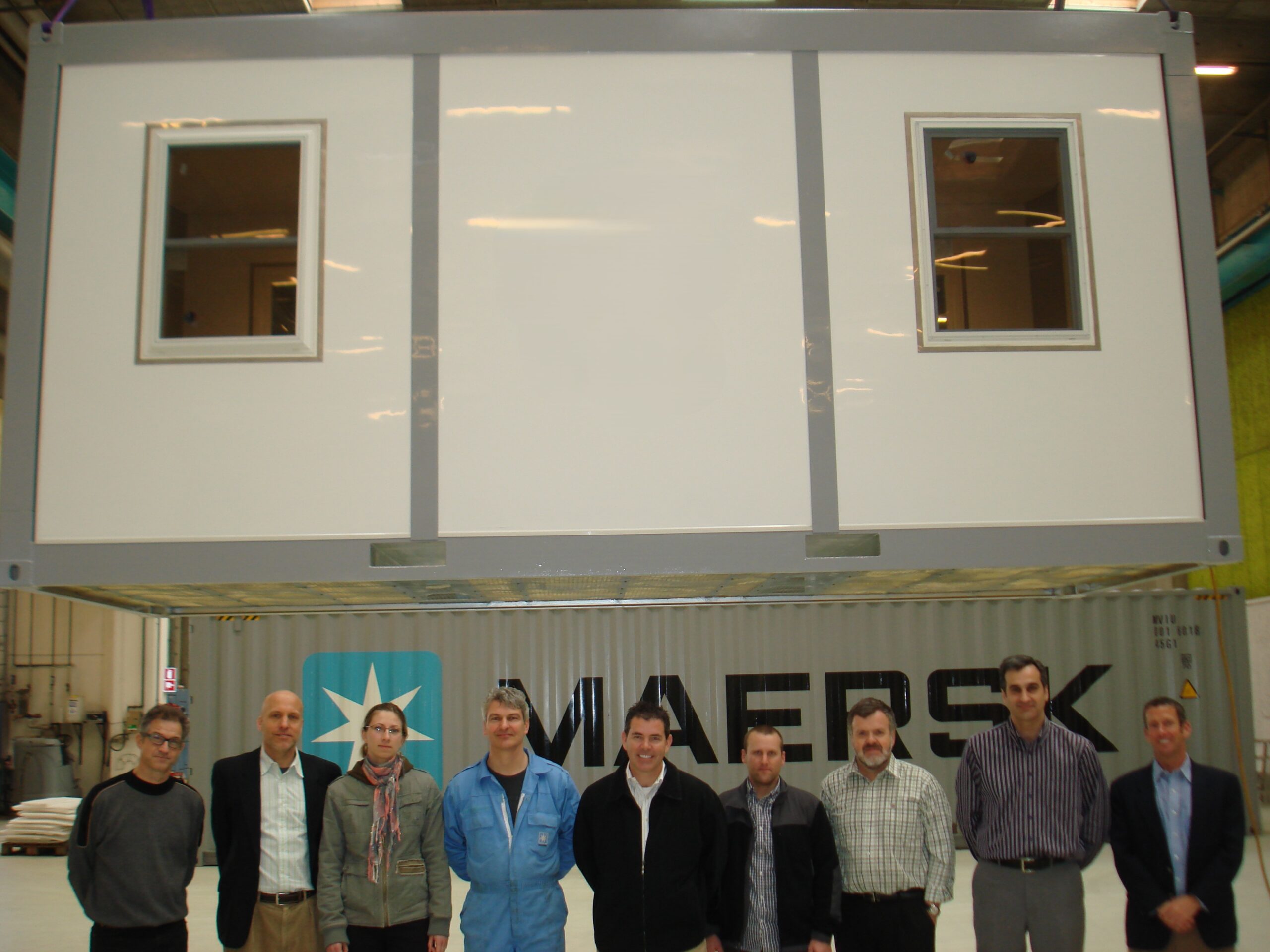
Cathcart and the joint development team at Maersk Container Industry, Tinglev, Denmark — the strategic manufacturing partner for large-scale production of modular building systems.
The Maersk relationship extended beyond the military program. When Cathcart deployed to Baghdad in 2009 as part of the Department of Defense’s Task Force for Business and Stability Operations, the modular infrastructure platform he had built with Maersk was central to the reconstruction framework he presented to Iraqi ministry officials — a system capable of delivering completed buildings rapidly into environments where conventional construction was not feasible.
On the commercial side, a Strategic Sales Agreement between Cathcart’s construction technology firm and Maersk Container Industry established MCI as the exclusive manufacturer of Cathcart’s modular building frames — a partnership capable of producing more than 32,000 modular structures annually. Cathcart subsequently sourced and negotiated an $80 million supply agreement with a former General Electric subsidiary to deliver rapidly deployable modular buildings to customers across the United States — a national distribution platform built on the same manufacturing and logistics infrastructure developed through the Maersk partnership.
High-Consequence Environments
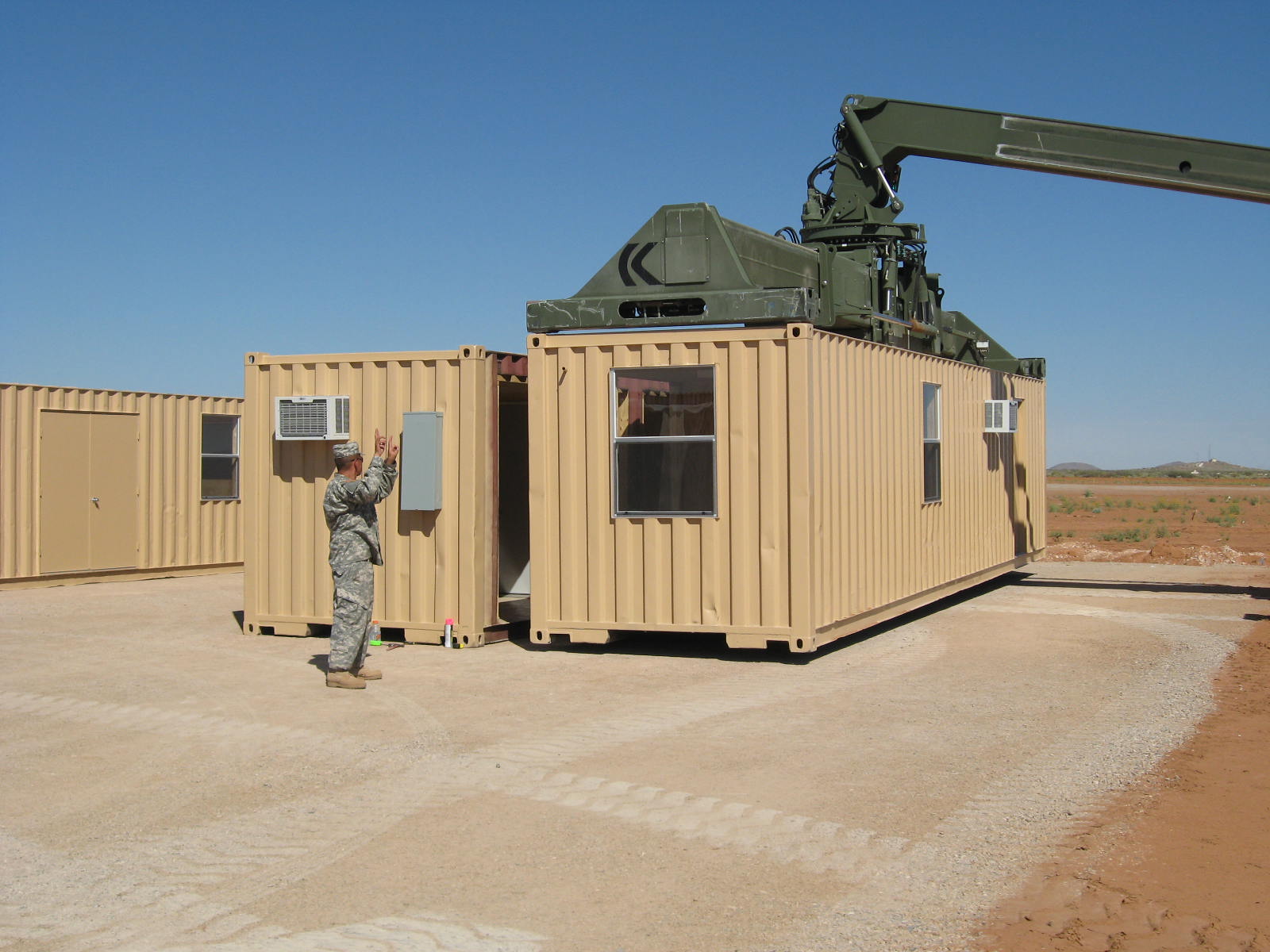
Modular buildings deployed at a U.S. Air Force test installation — rapidly deployable structures built for forward operating base environments and disaster relief operations.
The Haiti mission — and the ground-level complexity behind the Baghdad reconstruction framework — illustrated a different dimension of high-consequence logistics. In both cases, Cathcart operated in environments where conventional logistics infrastructure was damaged, absent, or politically unreliable. Scalable plans had to be developed and executed, and timelines were not abstract.
In Port-au-Prince following the 2010 earthquake, Cathcart coordinated directly with the U.S. Embassy and Haitian government officials to design and construct a complete modular school for 250 children with components manufactured in Texas on a pro bono basis. In Baghdad, he operated with Department of Defense logistical support, delivering reconstruction strategy frameworks to senior Iraqi ministry counterparts in the Red Zone.
Neither mission had a playbook. Both required judgment, improvisation, and the ability to move things through institutional and physical complexity simultaneously.
Caribbean and Cross-Border Logistics
Cathcart has also spent five years operating in the Caribbean, building Seven-10 Pharmaceuticals into a licensed, GMP-certified export platform in a Jamaica Special Economic Zone established by government order of the Prime Minister and gazetted in the Jamaica Gazette. That work required constructing a logistics and compliance architecture spanning multiple regulatory frameworks: Jamaica, the United States, Brazil, Mexico, and the Caribbean.
The Brazil pathway illustrates what cross-border pharmaceutical logistics actually demands. Securing ANVISA import approval for Schedule 1 controlled substances, establishing compliant export procedures from a Caribbean Special Economic Zone, and connecting into a distribution network reaching more than 13,000 Brazilian pharmacies is not a shipping problem. It is a regulatory, operational, and commercial logistics problem solved simultaneously.
A Caribbean logistics platform currently in development extends this foundation. Its mandate spans regulated-product movement, modular and containerized infrastructure deployment, and rapid-response operational support for disaster relief, reconstruction, and high-consequence environments across the Caribbean and Latin American corridor.
The Broader Pattern
Force protection systems that cannot be delivered are not force protection. Pharmaceuticals that cannot cross borders are not helping patients heal. Reconstruction materials that cannot move through a conflict zone do not rebuild anything.
Cathcart’s logistics experience is not a standalone credential. It is the operational layer that makes every other platform real.
For professional inquiries, contact Cathcart here.